Then I remembered my The Colour Star by Johannes Itten. It's a small box set consisting of a colour wheel and eight overlays and also an instruction sheet. I bought it some years ago after a workshop and tucked it away and to be honest, hadn't given it another thought. Well, I got it out and we set up the wheel and then checked out the various combinations. She went home with a whole new colour combinations in mind than what she thought she would be using!
 It seems that there was no given 'order' to colour, other than rainbows. It was a process learned by artists as they worked and was highly subjective and mainly intuitive. There was a start made to organise colour by Phillip Otto Runge in 1810. He used a globe to demonstrate his theories. Itten produced a star in 1921. ( if you click on Itten's name, it will take take you to a brief bio on him.) It's based on the primary colours of yellow, red and blue. All colours are made by mixing combinations of these and produce secondary colours of orange, violet and green. Six further colours complete the wheel.
First, there is the true colour or hue; if you add white to it then you get a tint; if you add black to it you get a shade ( think shadows!). When two colours are opposite on the wheel, or complimentary, where they meet they create gray. Ever heard the term "it's all shades of gray" ? Well it seems that gray can be quite helpful in showing us the depth of shade of a colour in a piece by using ten shades of gray as a scale. If colours are of a similar value of colour, they will work together better. Like I said, I'm no expert and there is a great deal of substance to the theory!
So back to the Star for amateurs like me. Let's look at what the Star does.
 The first disc is set down over two colours and they are 'complimentary' to each other. Where they meet they produce gray. I have selected two cones of orlec here to show them in the flesh ( so to speak )
 Next is a triad arrangement. I think my orange shade is too pale or doesn't have enough depth of shade.
 This one shows a primary colour, blue and two split complimentary. This is where you select colours on either side of the true complimentary. This is getting to be fun. I was pulling out cones from my stash and playing with different combinations!
  This is a tetrad where you use four or more colours on the wheel. I thought these looked nice together.
 Here's a tetrad based on 'opposites' and I found a stronger orange. It now holds its self better with the other cones. More intense colour saturation.
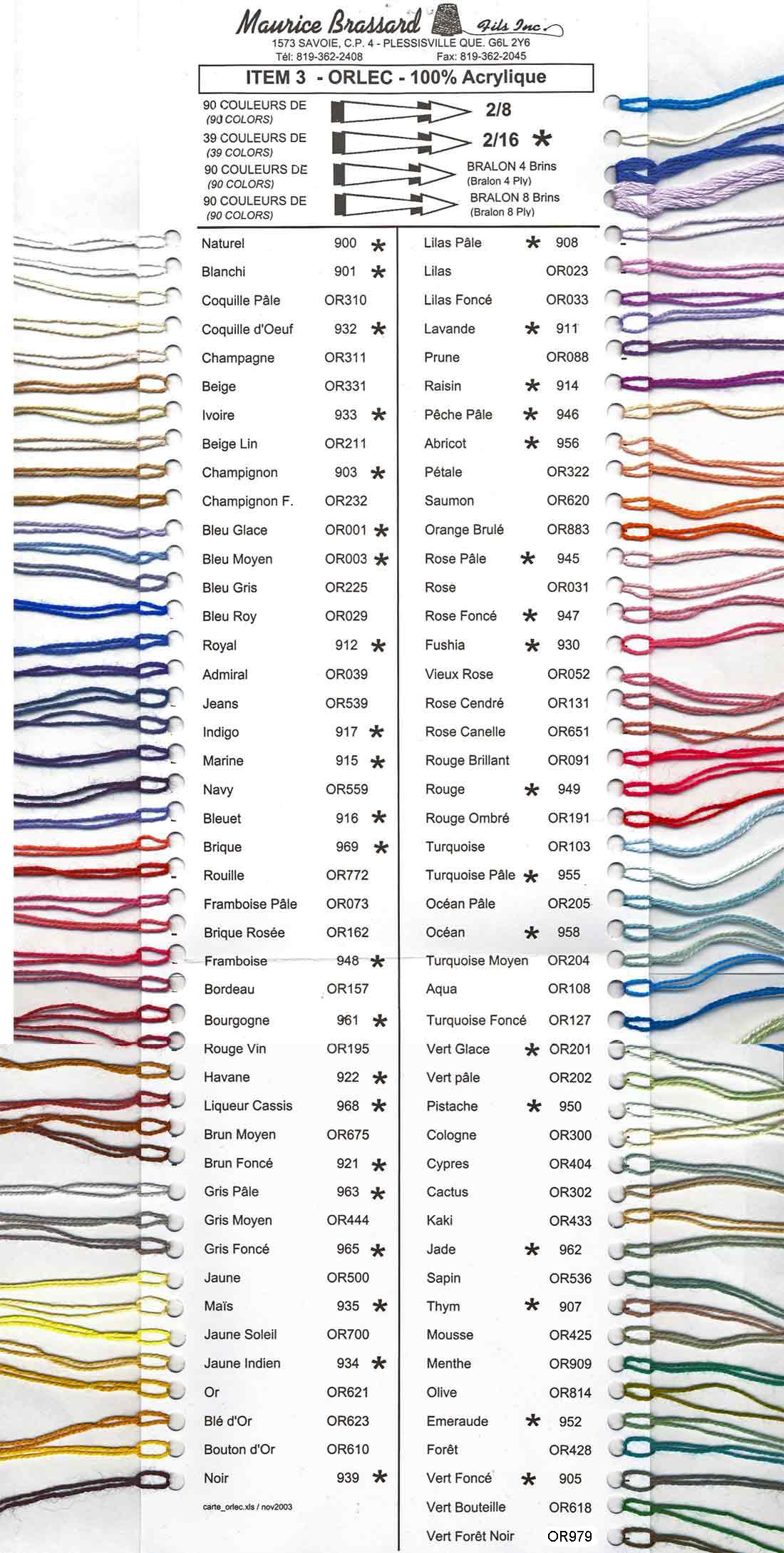
 Now this overlay is getting serious! It's a triad that uses colours on opposite sides of a true triad. I had to start using cottons to augment my orlec selections. {Orlec comes in 90 shades by the way...but I'm a bit shy of that!}
 This is another example of using a primary and now four split complimentary's. While these colours do work together, I'm not that crazy about this combination.
 This final overlay gives you a hexagon or six pointed star. If you study closely you'll see it incorporates three complimentarys. If you get the colour values or depth of shade just right, the potentials would be stunning! This one is a better balance than the previous overlay for me.
Now the Itten Star is wonderful and I am definitely planning to use it much more and most likely with each project to get more comfortable with my colour choices. It is a bit pricey to buy and my box says $41.50 but this was purchased way back when the Canadian dollar was only worth a pittance against the US dollar. I have another useful colour aid that I found at the artist supply store 'Opus'. It was about $10.00 and about as helpful! It's a colour wheel...
 By turning the outer disc you can see what happens when you add white, black, varying shades and there's even a gray scale.
 On the reverse there are the diagrams showing complimentary, split complimentarys, and triads and so on. A bit fiddlier than the star perhaps. I must admit that I would use the Star as it seems handier (read simpler!) for my needs.
 By turning the outer disc you can see what happens when you add white, black, varying shades and there's even a gray scale.
 On the reverse there are the diagrams showing complimentary, split complimentarys, and triads and so on. A bit fiddlier than the star perhaps. I must admit that I would use the Star as it seems handier (read simpler!) for my needs.
I had a good scan of my book shelves to see what else I have that is 'new to me' and found this book:
 There are some great pages in here on colour theory and even though it's geared towards spinners and carding machines, it all applies to us weavers. There's a gallery of projects made with hand dyed yarns that have been blended and hand spun. Some are woven tapestries! The colours are wonderful in how they work together.
 While this book by Deb Menz is now on my coffee table to read through, I found that I had virtually no other books on colour theory. What I do have is this delightful book by Victoria Finlay called "Color: Journey Through the Paintbox". It's a delightful read on the history behind various natural colours used by early man through to 19th century artists. The author did extensive research and traveled to find sources and answers. It was an enjoyable read...

Studio update: I have been slowly plugging away at the place mats and runners. More on the runners next time! I have been experiencing some difficulty with my left knee and right ankle. I'm heading off to get an x-ray on the knee this week and see what's going on.
 There are some great pages in here on colour theory and even though it's geared towards spinners and carding machines, it all applies to us weavers. There's a gallery of projects made with hand dyed yarns that have been blended and hand spun. Some are woven tapestries! The colours are wonderful in how they work together.
 While this book by Deb Menz is now on my coffee table to read through, I found that I had virtually no other books on colour theory. What I do have is this delightful book by Victoria Finlay called "Color: Journey Through the Paintbox". It's a delightful read on the history behind various natural colours used by early man through to 19th century artists. The author did extensive research and traveled to find sources and answers. It was an enjoyable read...
Studio update: I have been slowly plugging away at the place mats and runners. More on the runners next time! I have been experiencing some difficulty with my left knee and right ankle. I'm heading off to get an x-ray on the knee this week and see what's going on.
It's also time to start pulling the warp for the shawl commission. I'm still weaving and planning but just taking it slower!
So I'll close this time by wishing you a Happy Solstice. Yup, summer has arrived!