Pages

Showing posts with label 8 shaft huck lace. Show all posts

Monday, February 17, 2025

Peach of a Rose ~ Garden Shawls

 This post has been a while coming and the shawls shown here today mark the end of 16 years of  imagining, planning, weaving and finishing  scores of projects on my Spring Loom.   In all that time, she was never empty and always had something on the go.  A delight to weave on and frankly, hard to let go.   

Truth be told, it was time as my health has undergone some changes in the past 2 -3 years and it's time to weave less  and be under less pressure to keep two looms going and an Etsy shop full.  I don't know how weavers with multiple looms do it as there is only one weaver to keep all the balls in the air!

I still have my Megado and will still weave but my back tells me when its okay... when and how much.  Its Boss.   Simple as that...


So this first shawl has an undyed 10/2 tencel warp.  I bought some back when Webs used to carry it as it's a great staple to have on hand.   I used a 28 epi sett and my new 14 dent reed I got for Christmas in 2023 and it had patiently waited in its plastic sleeve.   

I find that setts where its 2 threads per dent show reed marks less. If you double or triple them up then it's going to show up.  Not all reed marks will wash out either.  So, an investment in a new reed was a good idea when I checked my stash and saw how much 10/2 cottons I have on hand 😳


The weft is a rose fiber yarn that I bought from Hilary at Crazy as a Loom (she may have more?)  Technically it's 'natural' but it does have a slight peachy hint of colour.  Neutral but something is going on there....   I like it!


The draft is an 8 shaft huck lace which always looks better with 'tone on tone' colours.   The tie up stayed in place and the looms new owner wove a scarf or two. It gave her time to get to know the loom before she had to tackle changing a CM tie up.   Which she did with her next project and quite well too. 


I wanted to try my hand at some fancy smancy borders and thought to give Danish Medallions a try.   I pulled them tight to for the ovals and didn't like what it did to the overall light-weight cloth. So I  just snugged them into place and they appear as an interesting feature as you can see from the picture above.  They are a slow hand manipulation  but very pretty and I'll try them again soon.  


Above you can see the drape and trust me, it's a light weave with a very soft touch.  Rose yarn is lovely to work with.   Below you can really see the peachy tint.  🍑 🌹


... and now for another garden extract..... Dandelion!  


When the time came to start the second shawl, I dug into the stash cupboard and found something interesting choices.  I had a cashmere blend but it was much too fine. Then I found mint fiber which was soft but while neutral, it still looked a greyed white.   I opted for a cone of dandelion fiber yarn instead as it had the right colour and silky look and feel to it I was looking for.  { I bought it at an Etsy shop called "YarnItaly" and they carry an ever changing inventory of exotic yarns }


Your can see the results as it looks like a white ivory and where there are weft floats there is a lovely sheen that catches the light.   I might keep this one for me.   Or maybe not since we need a new heat pump. 


Again lovely drape and you can see how light the fabric is. It would be like wearing a cloud!  ☁️


The border treatment this time was to mix up the huck treadling and create a band of pattern.   It was certainly faster than Danish Medallions. 


I tried taking the pictures outside but the huck lace vanished in the sunshine. Inside was much better but my flash unit wouldn't work so I had to brighten these on the computer.  Technology to the rescue...


So let me sow some seeds for thought:  You may be really keen to weave but please think about your overall posture at the loom, getting the right sized loom for you, and the right bench height.   Your elbow should be at a right angle and rest comfortably on the breast beam when you sit.  

Then think on time management: only fill 1-2 bobbins so you have to get up and move, stretch.   Take rest breaks. Don't weave if a body part is hurting. It's time to stop.  Maybe shift to another studio job instead.

One thing I have never done in all my 30 years of weaving, is to weave at night.  Daytime only.   I will use lights to brighten a dark day but never weave at night when your eyes are tired and straining.
Dark colours, such as all black are only woven on a bright summer day when you can see! 

Some years ago, on a dark winter day,  I wove a black on black lace table runner and couldn't see if I had made an error. I had to call out the treadling order verbally to myself thought out the 50-60 inches and only after it came off and was washed could I see if I got it right.  I did get it right fortunately as linen is too expensive to make that kind of mistake with!    
If you think all  these steps thoughtfully, then you will weave longer and be a healthier you.  💕


Wednesday, February 14, 2018

It Happens....

❤️ Happy Valentines Day  ❤️

 I finally have some weaving to show you and I have mixed feelings about it.  I used 9/2 French linen from Brassards as I have done many times before. This time, a new to me colour called brick. Its a coppery red and really a rich, deep colour.


It beamed on with no issues, threading went well and I laced it on okay. There were no threading errors or denting errors.... always a nice treat no matter how many years you have been weaving.  Its an  eight shaft huck lace draft, similar to my usual diamond lace but this one has two sizes of diamonds, that in turn have lace floats and all surrounded by all over huck lace.   I was looking forward to seeing it.

That's when the trouble started...


I couldn't really see it! These two pictures were taken to help me see the lace and if I was on track.  Photography is a good way to spot errors ( and recall what your start looked like!)


I had an overhead light, a floor lamp to the right of the loom, and a second one with two halogen lights to my left. What ever daylight there was was 'encouraged' by lifting venetian blinds up but it was dark and dingy out with heavy rain and the inevitable shorter winter days.   I was double checking the pattern as best I could along the edges and literally calling out the treadling as I went along. I placed large numbered pieces of tape on the treadles to help and took my time.   I caught a few mistakes and corrected them and literally crossed my fingers and hoped that was all of them!

A second issue arose but it was one I was expecting actually.  There is a difference in take up between the plain weave border edges and the all lace centre to the runners. The lace is thicker and builds up on the roll faster than the edges. Eventually it starts to cause some distortion at the fell line.   You can either cut off and re-lace on again, which gets expensive with linen, or try this trick.  Set in a round of warping sticks, best is only a bit longer than your warp is wide,  all tight up against each other and carry on weaving.  I had three runners on the cloth beam, each with a round of warping sticks. (I use warping sticks at the start to cover knots and such at the start, along with my two stick start method ).


I serged my runners apart where I had woven some scrap yarn.... then pressed the hem allowance into thirds.  I wanted larger, more generous hems this time and so wove six inches on either end of the three runners. It really shows the nicely tucked and tight ladder hemstitching off too!


I was amazed that I had a thread colour that was a close match and made a tiny stitch at each ladder and ran the thread through the fold to the next spot. I call this a running blind stitch but I'm not sure if that's the proper name or not...   I quite enjoy this step and usually do it while we watch TV, but once again I found there wasn't enough light on the job. It meant I had to do it in daylight, while under a halogen light. Don't let these bright pictures fool you.... they were taken with a flash.


The picture below shows the lace off tension and relaxed. You see a lot more of the pattern now but its still difficult. Only wet finishing will shift the threads to their proper places.


So a good long soak. Twice in fact as some fugitive dye come out in the first soak.  A rinse and then I rolled them into older towels to absorb the excess water. I had pulled them into shape and gently pulled on  the edges.  Then I lay them flat on counters overnight to dry.


The next morning I set up my Singer steam press and gave them a good fine misting of distilled water and pressed the heck out of the hems first.  Then I shifted to pressing them firmly down both sides of the runners, front and back.   This took a lot of the heavy work out of the job as I have arthritis in my hands and wrists.  Next was the ironing board to do the final finishing touches.  I  start in the middle of the runner and then pressing firmly move the iron out to the sides of the runner.  I do this 'pushing' motion all the way down the runner, then flip and do to the other side.  I find it stops that bowing  inward effect from the defined plain weave hems to the  central lacy part of the cloth. Your runner actually regains some width and looks nice and straight from hem to hem.

Now is it necessary to do this every time you launder the runner?  I don't think so. As weavers we are 'finishing' the cloth and that includes the heavy pressing that sets the threads into their final position. It is most likely that in the future all that will be needed is a normal ironing, although linen needs a hot steam iron to be wrinkle free (or a cold mangle).

So the runners were completed in January but as I mentioned it was simply too dark to take pictures. I tried though and deleted them all.   Then in early February the clouds parted for a brief hour and I dashed for the camera and runners!


The pattern really shows up nicely now. This runner is forty six inches over all and is error free. 😊


This one above is thirty six inches and has a small error. I got the wrong lace treadle on half a lace unit. ☹️  Can you see it?


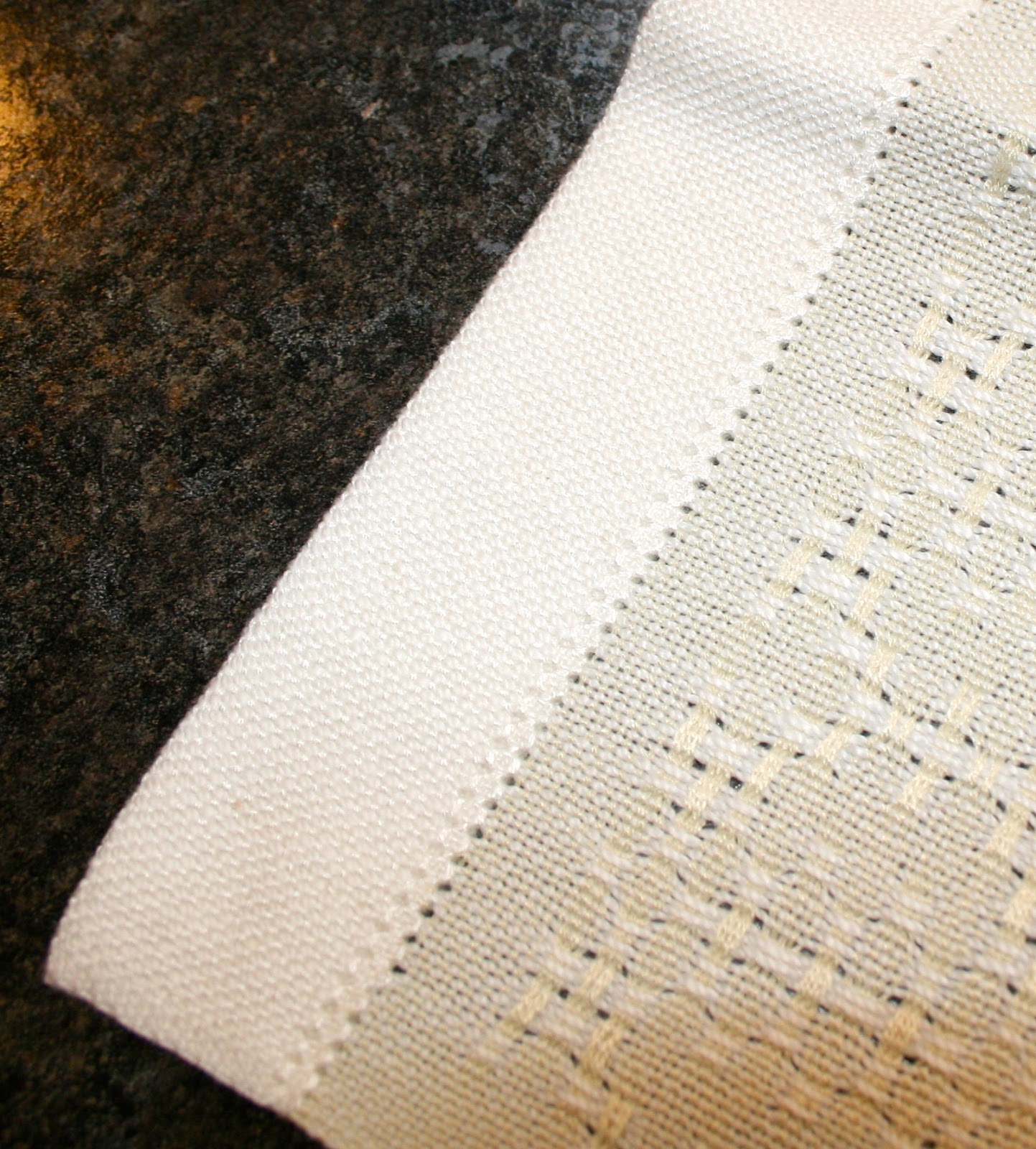
Here's a close up of the lace floats and all over lace... after laundering and hard pressing. It brought out the shine of the linen beautifully.

Then there is a seventy six inch long runner that is beautiful and also flawed.  😢  Some how, I missed treadling the reverse side of a small diamond shape. No other errors, just that..

A close up of the thread world.   So two runners out of three woven not 'perfect'.  I was pretty bummed out for a few days.   I started doing a mental review of the project of what I had done wrong and what I would do differently next time.  The answers are: get better lighting or simply don't weave such dark colour in mid winter. Especially lace weave that doesn't show its structure fully until washed. Weaving linen mid winter with drier interior air isn't a good idea anyhow....

The over all effect of the lace.

So the two runners are being sold as seconds as it would take a practised eye to find the spots. You and I could as weavers but it simply may not be that important to someone else.  They are hand made and 100% linen and quite lovely.    Very few things in life are perfect..... but that takes us down a  philosophical road.....


Monday, October 30, 2017

Frost on the Pumpkin


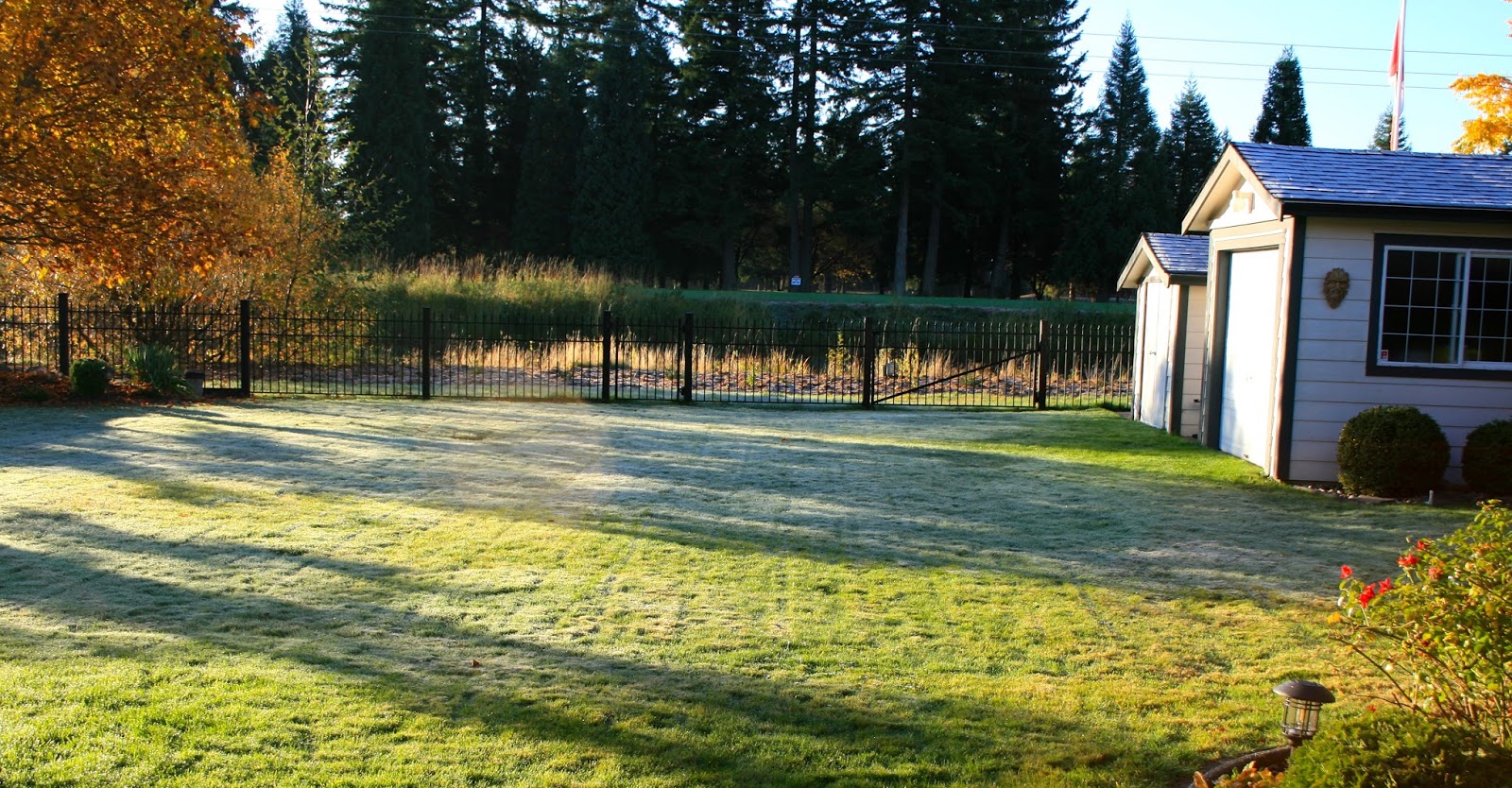
If we had any that is.....   The grass sure looked crisp this morning but in the time for me to run for the camera and come back, the sun had warmed parts of the lawn.  You can see it recently got its last cut for the year and a newly purchased leaf rake and leaf bags are waiting for the inevitable!


You have to admire those last few roses that keep on blooming! (bottom right corner).

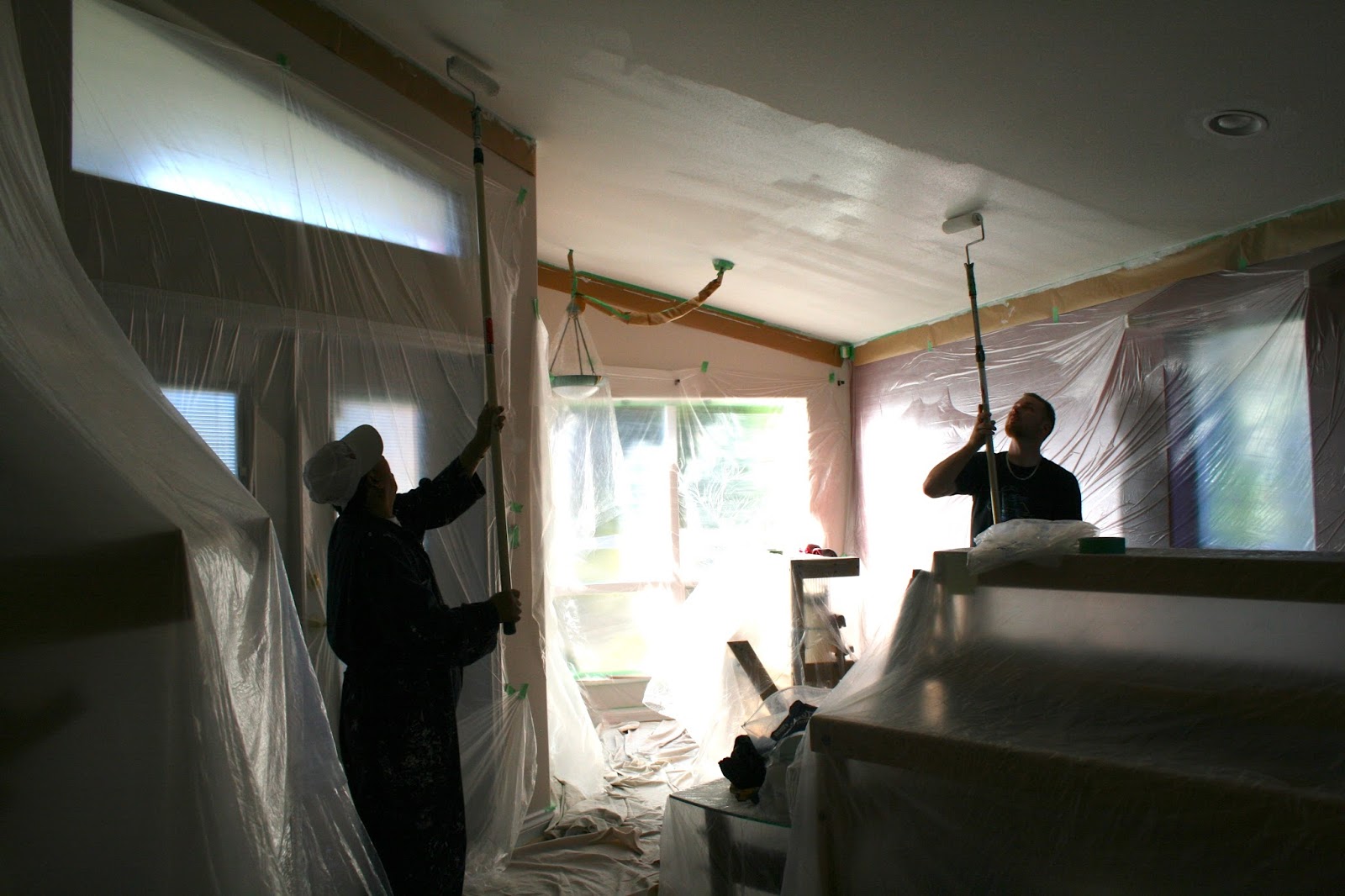
Meanwhile, inside is all organized chaos.   These were taken Saturday and shows the ceiling getting its second coat of paint.  By my reckoning, the tall guy on the right should be on the higher ceiling to the left and vice versa. Its interesting how they use the lighting conditions to show them where they have done and where the next stroke of the roller should be.    Much like using a play of light on tone with tone weaving... 


Normally there is just the two painters. Lovely couple who have been painting homes for over 30 years together. 


Much of this plastic drapery disappeared today and they are settling in on the walls.  Bathroom has its two coats on both ceiling and walls.  

Meanwhile I hope to get this big pile of stuff back into the room soon. Bruce is emptying his den / office and they are heading to the other side of the house next.  I can't imagine what doing the main open areas will involve next spring....   I'm going to like the end results, but no one said I had to like the process of getting there!


So my latest project is off the loom and had hand sewing of the hems done, then washed, dried and the "bejesus" pressed out of the linen using the steam press and regular iron and board.   Then tagged, wrapped and boxed to go off to Virginia.    Sorry no pictures this time round.  It was two runners 15 inches by 58 inches, plus a third one of 15 inches by 77 inches.     I had planned for a fourth runner of 15 by 58 but it came up short at 45 inches.  Being a thicker grist yarn, the take up was more than I allocated for. Notes will be made on the record sheets to that effect for the future! It seemed safer to get them wrapped and protected and shipped on their way rather than leave them in this chaos. I had no where to take pictures of them anyhow.


There's going to be one last warm summer like day today and I'm going to sit outside and spin on my wheel and enjoy the Fall colours in our back yard.  Apparently from tomorrow onwards it will be below freezing at night and just barely above freezing during the day. Possibly snow on Thursday or sometime on the weekend.   oh, joy!    Hub has tuned up the snow thrower and brought in extra gasoline to run it. 


Happily, it will be a dry night for the little ones trick or treating on Halloween!


Saturday, November 14, 2015

If at First You Don't Succeed.....

We had a nasty rain and wind storm recently and the next morning as the sun broke through, this fine fellow came and sat on a branch near our house to fluff up and dry off.  Its a sharp shinned hawk and the first one that we have seen here. He stayed for over an hour warming up and having a major preening session.  I guess if we put up a bird feeder they would visit more often..... as it eats other small birds that eat seed off the ground.  Ah, we won't be doing that....


If we could roll the clock back a few weeks..... okay, a couple of months at least!  I had wound a fine linen warp of 40/2 of approx 10 yards in length. I was looking forward to weaving up some guest towels and enjoying that crisp look that comes with linen and hemstitching! This was the very start and a test bit to check the threading:


The sett was 36 epi and I had used this before with great success but this time it wasn't working so well for me. The warp threads were literally binding on each other.     Okay, so I resleyed to 32 epi, thinking the reduction of four warp ends would give them more elbow room.      Apparently not....

So a third sley and the sett is now 28 epi and now only some were grabbing each other where they were in the same dent and the tension was all screwy on the left hand side.  I also really didn't like the way the warp threads were bunching up  and producing very heavy reed marks.


So I sat and considered my investment of time and yarn:  its been threaded twice,  I fixed two threading errors, resleyed three times and its still not resolved.   I wanted to have this project on, woven up and off the loom before I  went for my surgery the end of September.  The goal was to be able to hand sew the hems while I recovered. I also wanted to get a new warp on the loom so it was all set and ready to weave when I was ready to get back in the game.

So out came the scissors....     Yup, all of it, in the garbage.    No regrets.

So I adjusted the project to work with 10/2 cotton and got busy winding a warp of natural colour mercerized cotton.  Bruce helped me wind on the eleven yards. This time everything went just right! There were no threading errors, no sleying errors, nice even warp tension and the 24 epi sett worked beautifully.

*Big sigh of relief!*

I wove my hem allowance, then hemstitched every four warp threads. Then I placed a thick cord and then started on the border.  I pulled out the slippery cord out and then hemstitched the top edge.    Complete the lace detail in the border and then hemstitch the top edge.   Place the cord again and weave the initial plain weave shots for the main portion of the towel. Pull the cord again and hemstitch the final edge using what ever colour of weft is being used for the towel.     {If you give this a try yourself, be sure to leave  five times the width of the project for the hemstitch yarn. }


Virginia West's classic book  "Finishing Touches for the Handweaver"     This book is a real treasure if you wish to have your work beautifully finished. It was a game changer for me when I got my copy nearly twenty years ago!

I had purchased some cones of yarn in a series of soft neutral colours in a fine bamboo (6300 yds/lb) and decided to use them as my weft. The Bambu 12 is soft, has a great sheen and and would give the towels a lovely hand. They would be naturally anti microbial and anti fungal which is a nice property to have in a small towels that might sit wet after hand washing.

I'm weaving an eight shaft huck lace that makes a repeating diamond pattern. Its something I had played around with in my Fiberworks program.  I planned to make half the towels with the diamond motif and the other half would have a design I'm calling lattice and flower. I played around with the treadling options to find a pleasing pattern.

I had a project plan guide beside me:  three inches for the hem, a total of eighteen inches for the main part of the towel (including the fancy border), then three inches for the back hem. The hems and border were done with white against the natural, with a colour for the main part of the lace.   I used white for the back hem as well and did full hemstitching where they changed.  {be sure to use seven times the width for this style}. See below and remember to click on the pictures to enlarge:


So that was five rows of hemstitching per towel and over a dozen towels that totals 60 rows altogether.   What the heck was I thinking??   Do a fast project and get it off the loom and reloaded before my surgery date???   I also had to warp up and load the Megado and then we decided to re-assemble the tapestry loom over leaving it as a pile of lumber on the floor.   Timing was going to be tight!

The tapestry loom was re-built, and the Megado loaded. That would be the first choice of loom to weave on thanks to the one treadle and light action so it made sense to get it done first.  After that, I worked away on the towels and got my speed in hemstitching up to new world record speeds!    It was tight for time but the warp came off and a new one went on the same day which also included being hoisted up on crates to change the tie up!

I measured and pressed the hems and pinned them .   It was a nice stack of hand work waiting for my return!   Then, I indulged in a studio cleanup too which I must admit felt real good. My creative work space was all set for when I would be ready.


Anaesthesia does funny things to your head. It makes you fuzzy minded and clumsy for a time. Its surprising how long it lasts in your system. Then there's the pain meds after surgery which add their own complexity to the mix.   I guess it was nearly 3 weeks after my surgery that I was interested enough to try sewing hems.  The cloth was quite fine so good light was necessary but I slowly inched my way across one hem after another.  


Last week I placed them into a gentle wash cycle  and once spun out, I trimmed off any tails and let them line dry over night.  Next morning I lowered the ironing board and pulled up a chair.  I steamed pressed them and I'm very happy with them!  I found only one that had a treadling error, which we politely call a second.

Its a tough time of year to photograph anything.... its so darn dark!  But with every light on in the house and using the 'brighten' function in my editing program I got some nice pictures.  There are six towels with the diamond pattern....


There are five towels with the lattice and flower pattern:


They measure thirteen inches wide by nineteen and a half inches in length. The colours are a soft butter yellow, green tea green, snowy white, a light beige called water chestnut,  and a blue green. The sheen from the bamboo is lovely and the fine cloth has a nice weight to it.   If we do get a bright sunny day, I might try re-photographing them, but this will have to do until then.

So this project was all woven before my surgery (on a wonky knee no less) and I'm happy to report that I have made a start on trying to weave again this past week at six weeks post operative!

I did do some work on the Megado, where I used mainly my right leg for 30-40 treadlings then I would do 10-15 with my left leg and so on. I took the next day off to see how it felt and it was fine.


So yesterday I sat down on my bench and tried two treadling repeats at my Spring loom:


In the case of this treadling plan there is an even division between left and right leg so they both got an equal workout. It didn't feel too bad at all!  I did only two repeats.  My physiotherapist has given me the go ahead to weave and called it a "great quad strengthening exercise" and asked if I had a spinning wheel too?   I said yes and she she told me it was okay to use it as well! 

I'm not 100 % as yet and still a lot of inner healing and more exercises to go, but I feel like I'm finally on the way back!