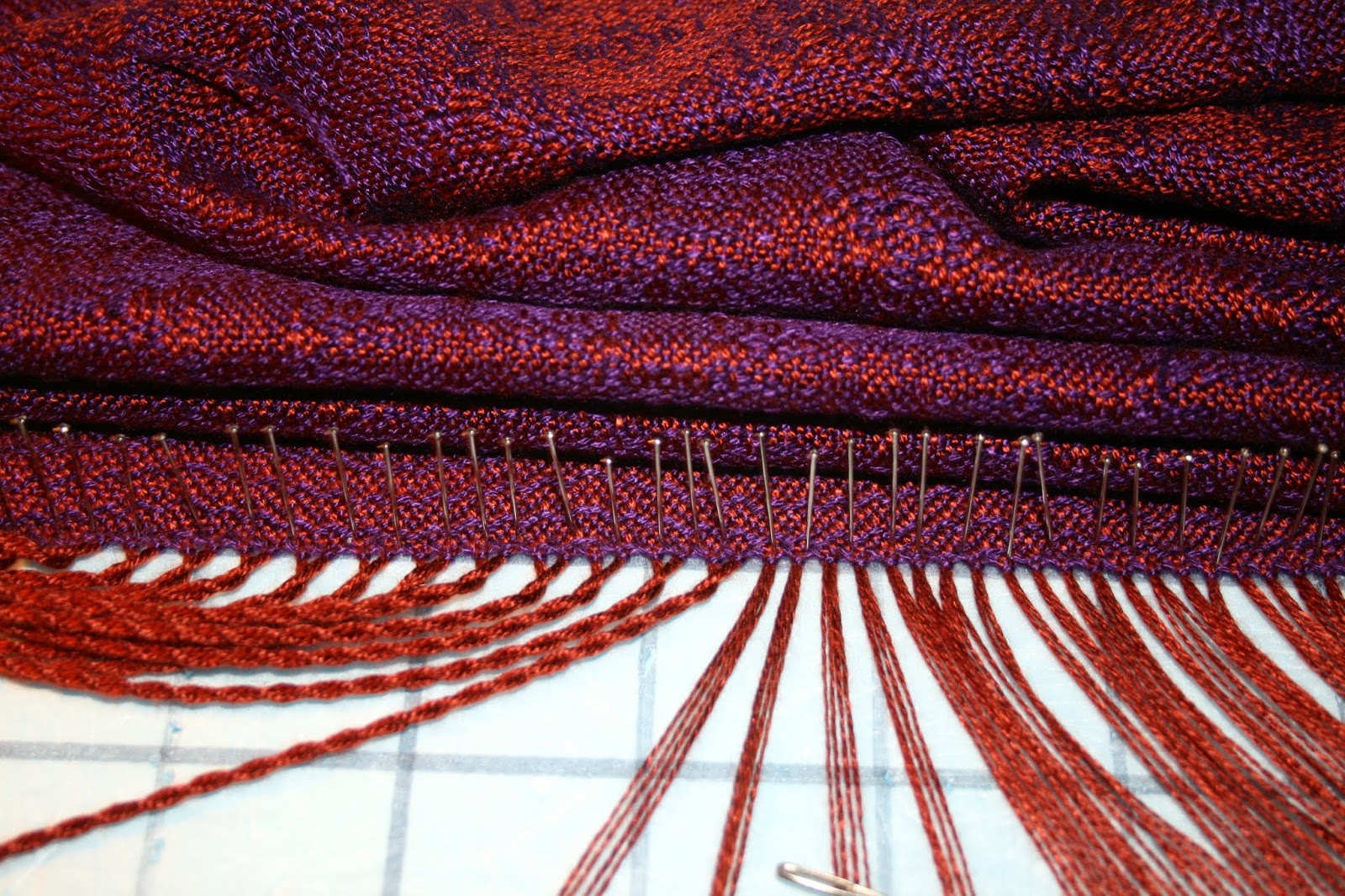
I have spent the past few days finishing the Dress Stewart towels. It was rather exciting when I placed the entire eight yard length into the washing machine to soak for a spell. I wandered by after ten or fifteen minutes and checked.....and the water was this dark murky pink muck! The dyes were coming out and I had to do something fast!
My synthrapol is in a box somewhere in the garage.... but as luck would have it, a friend had gifted me a couple of boxes of the Shout Colour Catchers. I had already used a couple of sheets but this was an emergency and so I dumped the rest of the box in. I think it was six or eight sheets. I didn't count them (or take a picture after....darn!)
The cloth came out white where it should be white and the colour catchers were totally a dark pinky grey colour. They worked and saved the day! After the towel warp was machine dried, it took me some time to carefully snip off all the little weft tails. I actually took it to my guild meeting for show and tell as a bolt of material. It weighed a kilo (or 2.2 pounds) and made a nice satisfying roll.
I cut the towels apart using the serger. The cut line was every thirty one inches at the end of a colour repeat which made it much easier! I turned a small rolled hem and hand sewed the hems.
Yes, I know it would be faster to machine them but I'm not a fan of the 'stitch ditch line' as it distracts from the tartan lines. I can't always be sure that they will be used as intended and they might end up as a runner.
While I sewing them, I found myself thinking of my first tartan experience as a child. I had a pair of Stewart tartan trousers and while I liked the pattern, they made my legs itch from the wool. Mum would dress me up in them anyway....

They were the full red version of the Stewart. Me in 1958, in the UK.

I also had tartan pinafore dresses, though I don't recall the colours of this one. I think it was mainly green. A young me with Father Christmas, 1958.
So I can hear you asking, are you Scottish? Not a bit! I'm a true Sassenach. My forays into our family genealogy have revealed southern English, with a dash of Welsh back to my 6 x great grandfather, William Vincent.
.....but I digress....
It seems everyone wore tartans or plaids in England and I feel that Queen Victoria and the Royal Family helped to make it popular. She wore tartans quite regularly and made it fashionable (along with the all white wedding dress). (If you have been watching PBS's Victoria recently, the Queen's son Bertie wore a kilt and sash in Dress Stewart in the grand finale.)
It seems everyone wore tartans or plaids in England and I feel that Queen Victoria and the Royal Family helped to make it popular. She wore tartans quite regularly and made it fashionable (along with the all white wedding dress). (If you have been watching PBS's Victoria recently, the Queen's son Bertie wore a kilt and sash in Dress Stewart in the grand finale.)
Better historians than I can give you the story of the Scottish Highlanders and their sad history, but suffice to say that after the Battle of Culloden April 16th, 1746, Highlanders were banned, upon pain of death, to wear clan colours and regalia.
Anti-clothing measures were taken against the highland dress by an Act of Parliament in 1746. The result was that the wearing of tartan was banned except as a uniform for officers and soldiers in the British Army and later landed men and their sons.[69]

I wasn't immune from the new found popularity of the show and wove up a plaid using colours from my stash, in a plaid arrangement I called "Highland Heather" five years ago:


I have also woven up tartan Mackenzie #2:

So what is the difference between a plaid and a tartan? People us the terms interchangeably but is this correct? Wikipedia says:
Tartan is particularly associated with Scotland. Scottish kilts almost always have tartan patterns. Tartan is often called plaid in the United States, but in Scotland, a plaid is a tartan cloth slung over the shoulder as a kilt accessory, or a plain ordinary blanket such as one would have on a bed.
I personally view tartans as distinct, recognized and registered patterns by the Scottish Tartan Authority and plaids is a pleasing arrangement of colours and stripes much like my Highland Heather towels. I may well be wrong on this but it feels okay to me!
So who can have a tartan? Well, anyone really! There are official registered tartans for every province or state, or country in the world.
 |
| Books by Iain Zaczek are amazing resources. Don't let the last name fool you! (ISBN # 1 894102 43 6 and ISBN # 1 552671 79 8) |
Do you have Scottish ancestry? You can find your clan or sept in books like these:
 |
| There are weaving sett guides and history in this book by Maria Constantino (ISBN # 1 895464 20 X) |
 |
| Gordon Teall & Philip Smith jr have authored a classic district guide, complete with setts and histories (ISBN # 0 85683 085 2) |
What about weaving tartans or plaids yourself? Are there rules? Well, the short answer is 'yes'. A true tartan is always a balanced 2/2 twill. This simply where the threads go over two and under two and can be woven on a four shaft loom. The tricky part is the word 'balanced'. The sett must be just right so that the twill diagonal line when measured (off tension) is a 45 degree angle.
So to be truly finicky, to get 24 epi and 24 ppi for example, you must sley the reed at something like 22-23 and beat so you get 22-23 picks in so when its off tension and wet finished and pressed it becomes the magic 24 either way. You have to know your chosen yarns very well and how they react under tension, keep your beat even, and anticipate what they will do when wet finished and pressed. That means sampling and more sampling.... ( I speak from experience as I wove a balanced twill for the Guild of Canadian Weaver tests)
Well, doesn't that sound like fun? 😳
Unless you run a textile / weaving mill, such as Lochcarron of Scotland where such standards prevail, most weavers do their best to get just a smidge under the 45 degree line on the loom, knowing it will balance out after a wash and press. Close enough! So for my recent towels I used 8/2 cotton sett at 24 epi. I got a decent twill line and quite frankly, I haven't checked it after washing and drying. They look nice as they are.
So why choose Dress Stewart for my project? Well, I have always liked the Stewart tartan but it came down to what colours I had on hand in my stash. I had some red on hand but not enough if I wove the full Royal Stewart with its wide bands of all red in between the multi coloured sections.
 |
| Stewart Dress tartan draft |
There are three categories of colours used by weavers to guide their choices:
- Modern colours: 19th century aniline dyes replaced older natural dyes. They are bolder and have rich depth of shade.
- Ancient: this doesn't not denote the actual age of the tartan but indicates that natural dyes (from various sources) were used and have a softer more natural tint.
- Muted (or also known as reproduction) colours: introduced in 1946, based on old bits of textiles found at the battle site of Culloden. They were tartans dyed using natural dyes, but then muted by their exposure to peat. There is a further softening of the colours, especially greens and browns. Used for hunting tartans and plaids as they would blend into the hillsides. {sort of like old Scottish camoflage !}
There are many resources on line but I have three books on hand that are focused on hand weavers and reproducing tartans. I'm sure there are many more out there, plus resources on line if you do a search.
 |
| This small book by James D. Scarlett is the tartan weaving chief guide! |
The Tartan Weavers's Guide by James D. Scarlett ( ISBN # 0 85683 078 X) was particularly helpful in learning the colour sequencing and understanding the pivot colour.
While there was three groupings of colours to chose from, they did standardize the abbreviations for the actual colour words:
A: light blue (azure)
B: blue
C: rose (crimson)
D: dark + colour used
G: green
K: black
L: light + colour used
Lil: lilac
Lv: lavender
Ma: magenta
Mn: maroon
N: grey (neutral)
P: purple
R: scarlet (red)
T: brown (tan)
W: white
Y: yellow
Then from the Lyon Court came these additional symbols:
Az: azure, sky blue
Gu: Gules / Scarlet
Vt: vert / grass green
Br: brown
Bk: black
Wh: white
Purp: purpure / purple
Bu: a duller blue
Red: a duller red
C: crimson
Gr: a duller green
Y: yellow
Let's use my draft of Stewart Dress: W 72, B 8, Bk 12, Y 2, Bk 2, W 2, Bk 2, Gr 16, R 8, Bk 2, R 4, W 2
If you study this warp colour bar from the Stewart Dress draft and follow along reading right to left, you will see how they only needed half the order (for symmetrical tartans). Click to enlarge.

Many know of Mary E. Black and her book Key to Weaving and New Key to Weaving (depending on the publication date). There is a brief chapter on weaving tartans and plaids, of which she was especially fond. Mary Black was one of the founders of the Guild of Canadian Weavers and was their very first Masterweaver and her thesis was on Tartan Weaving. There is a small booklet produced by Lily Yarns by Ms Black. No publication year is given but I estimate it to be circa 1950's. Its a real little gem!
 |
| GCW Founder & Masterweaver, Mary E. Black (no publication date other than 10M-1-59 Printed in the USA, which I assumes means Oct.1st 1959, by Lily Mills Co. of Shelby NC |
Roll the clock forward to 2018 and I found this delightful new weaving guide :
 |
| ISBN # 9781723818028 or the Amazon here |
Linda covers a lot of material on weaving tartans for current times, including designing your own, and the practicalities of setting up the warp for weaving and setts. There is even a section on twill variations to move beyond a 2/2 twill (gasp! 😳). She shows how to use a chart and spread sheet to plan a successful tartan project.
Speaking of successful projects..... how did mine turn out?

Well, I cut them every 31 inches apart as it ended nicely with the end of the colour repeat.

I turned a small hem and pressed, then hand sewed the edges using a running blind stitch. I planned these as kitchen towels but they may end up as a runner in someone's home or? Does hand sewing hold up to machine washing and drying? Yes it does as all my kitchen towels are hand sewn and are in and out of the wash constantly.

The edges look okay.... just a touch of crowding. Not too shabby given that I didn't use a temple!

I got six towels measuring 20.5 inches by 29 inches in length plus a bonus table square (no sample this time). The bonus square is winging its way to Australia as a gift as I write. Seems that some of the Stewart Clan made for the far flung corners of the world!